

You gave them a pay rise. They’re still leaving.
Clear sees both sides of this equation every day. We’ve made 160+ placements for Data Center operators and contractors including NTT, VIRTUS, Winthrop and Dornan. We’re the ones who get the call when the engineer who left 3 months ago still hasn’t been replaced. We’re the ones sitting across from the hiring manager who says: “I offered 15% more. He took it. And he’s still handing in his notice.”
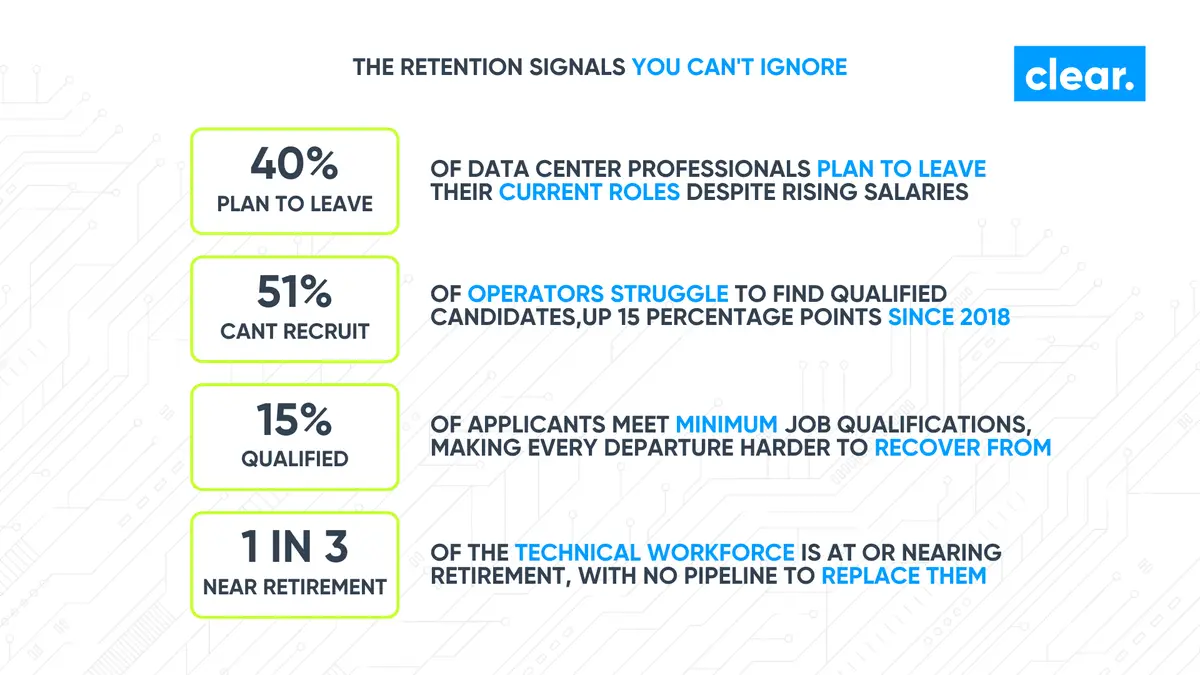
The Uptime Institute reports that 51% of operators can’t find qualified candidates. But the number that should worry you more is this: 40% of Data Center professionals plan to leave their current roles despite rising salaries, citing burnout, limited career development and poor work-life balance.
In a sector where only 15% of applicants meet minimum qualifications, and global capex is approaching £750 billion in 2026 as hyperscalers race to double capacity by 2030, every departure isn’t just a vacancy. It’s a programme risk. It’s uncommissioned megawatts. It’s capital that can’t convert.
Retention Is a Capital Deployment Risk
We hear this from Programme Directors constantly: “I have 3 sites mobilising in Q2 and I need 15 commissioning engineers across them. I found out yesterday that 4 of my contractors are finishing and haven’t given me notice.”
That’s not a recruitment challenge. That’s a delivery crisis.
When a commissioning engineer leaves mid-programme, the cost isn’t their salary. It’s the 3 months it takes to find a qualified replacement. It’s the contractor brought in at premium day rates. It’s the site-specific knowledge that walks out the door, the familiarity with scripts and sequences that can’t be downloaded from a shared drive.
And in a sector where uncommissioned capacity represents lost revenue against pre-committed tenants, every week of delay is measured in millions, not days.
Operators and contractors who fail to align retention with capital deployment timelines will lose ground to competitors who’ve already worked this out.
For OEMs, the picture is equally stark. Field service engineers are being poached by operators offering 20%+ salary premiums. The engineers who leave take product-specific knowledge with them: UPS systems, switchgear, chillers, BMS platforms. Years of expertise, gone overnight.
Clear has made 83+ placements across power and cooling OEMs including Anord Mardix and Airedale. We know how hard these roles are to fill. Losing the people already in them is a cost most organisations haven’t properly quantified.
The Real Reasons People Walk
Salary has become table stakes. It gets someone through the door. It doesn’t keep them there.
The reasons are consistent. Burnout from understaffed teams carrying too much load for too long. No visible career path, 3 years in the same role with no conversation about what’s next. Poor work-life balance on programmes with aggressive timelines and thin resource. And a feeling, sometimes hard to articulate but impossible to ignore, that the organisation values its projects more than its people.
Every one of those is fixable. None of them are fixed by a compensation review alone. And none of them show up in an exit interview conducted by someone who wasn’t paying attention for the previous 18 months.
AI Data Center projects, which require 2 to 4 times the workforce of traditional builds, are making all of them worse simultaneously. More pressure on smaller teams. Longer hours on more complex programmes. The same retention risks, amplified.
What the Organisations That Keep Their People Do Differently
The companies retaining their best engineers aren’t doing anything revolutionary. They’re treating people strategy with the same rigour they bring to programme controls or commissioning plans. That’s the difference.
Progression that’s visible, not implied
The most common complaint Clear hears from engineers considering a move isn’t about pay. It’s “I can’t see where I’m going.” They’ve been in the same role for 3 years. Nobody’s talked to them about what comes next.
From site engineer to lead. From lead to manager. From manager to director. The organisations that retain well have mapped this clearly. Not as a vague promise, but as a documented pathway with defined competencies, timelines and support.
Engineers don’t leave organisations that invest in their futures. They leave organisations that forget to.
Workload managed before it becomes burnout
Understaffing is the norm. Teams carry vacancies for months. The people who stay absorb the load.
That works for a while. It doesn’t work for a year.
The organisations getting this right use contract and freelance resource to manage demand spikes rather than stretching permanent teams to breaking point. Clear’s Contract & Freelance division deploys pre-vetted commissioning engineers, project managers and QA/QC specialists within days. It’s workforce management, not emergency response. And it gives permanent teams the breathing room they need to stay effective and stay engaged.
Then there’s culture. It sounds soft. In mission-critical environments, it isn’t.
Culture isn’t a poster on the wall.
It’s how a programme director handles a commissioning delay.
It’s whether the engineering director knows what their team delivered last week.
It’s the gap between what the company says it values and what it actually rewards.
Close that gap and retention improves. Leave it open and no salary benchmarking will compensate.
Why Embedded Partners See the Problem Before You Do
Here’s a pattern we see repeatedly. A client engages us to fill a senior commissioning role. We ask why it’s open. The previous hire left after 8 months. We ask why.
The answer is usually one of the reasons above.
A transactional agency fills the role and moves on. An embedded recruitment partner asks the harder question: what needs to change so the next one stays?
This is what Clear was built to do. Every consultant works exclusively within Data Center, power and cooling infrastructure. We don’t need a commissioning manager role explained to us, or what IST means, or why a 15-week programme delay costs more than the salary of the engineer who could have prevented it.
When we operate as an embedded partner, whether through retained search, RPO or an ongoing contract relationship, we bring a dedicated 3-person delivery team aligned to the client’s programme timeline. Pre-vetted shortlists typically within 1 to 2 weeks. Biannual salary benchmarking based on live placement data, not survey averages from 18 months ago. And the consultative depth to advise on both sides of the workforce equation: who to hire, and how to keep them.
The organisations converting capital into commissioned capacity fastest aren’t just hiring better. They’re retaining better. And their embedded recruitment partners are a core part of how.
The Organisations That Win This Will Win Everything
The next 5 years will define who delivers on the Data Center supercycle and who falls behind. The capital is committed. The programmes are live. The question now is execution.
And execution depends on people staying, not just arriving. The competitors who’ve already connected retention to delivery are moving faster, commissioning faster, and pulling further ahead.
Retention isn’t an HR initiative.
It’s programme delivery infrastructure.
Clear has spent 9 years as a specialist recruitment partner to organisations that build, operate and service mission-critical infrastructure. From London, New York and Dubai, we help clients commission capacity, operate assets and scale leadership teams. If you’re losing engineers faster than you’re replacing them, we’d welcome the conversation.
clear-er.com


