

Here’s what we’re hearing from hiring managers right now: “I’ve got a £400 million programme mobilising in Q2 and I can’t find a commissioning manager.”
Not a junior engineer. Not a niche controls specialist. A commissioning manager. One of the most fundamental roles on any live Data Center build. And they can’t fill it.
This isn’t an isolated conversation. It’s the pattern across almost every client engagement Clear has run in the past 12 months. The capital is flowing at record speed. The talent pipeline hasn’t kept pace. And the gap between the two is where programmes stall, milestones slip, and competitors move ahead.
Global Data Center capex is approaching £750 billion in 2026. The 5 largest hyperscalers have raised their spending projections to roughly $750 billion this year, a 67% year-on-year increase. Up to $3 trillion in total sector investment is forecast by 2030. Nearly 100 GW of new capacity is expected to come online, doubling global infrastructure in under 5 years.
The money is committed. The people aren’t.
The Numbers That Should Worry You
51% of Data Center operators struggled to find qualified candidates in 2024, according to the Uptime Institute. The biggest gaps were in junior and mid-level operations, mechanical and electrical positions. Only about 15% of applicants meet minimum job qualifications, and positions routinely take over 2 months to fill.
A third of the technical workforce is at or nearing retirement. In North America, employees over 55 outnumber those under 30. And 40% of Data Center professionals plan to leave their current roles despite rising salaries, citing burnout, limited development and poor work-life balance.
Salary alone isn’t fixing this.
Meanwhile, AI Data Center projects require 2 to 4 times the workforce of traditional builds. Demand for HVAC system engineers has grown 67% since 2022. Robotic technicians: 107%. Industrial automation technicians: 51%. Rack densities have surged from 41 kW to 130 kW and beyond, with projections reaching 250 kW. The facilities being commissioned today bear little resemblance to those built 5 years ago, and the talent pool hasn’t evolved with them.
Talent, rather than shortage of power or semiconductors, may become the primary barrier to scaling AI infrastructure.
The UK picture alone makes the point. Over $59 billion in Data Center construction has been announced since 2023. Microsoft has committed $30 billion to UK cloud and AI infrastructure. Google has announced a £5 billion 2-year investment. Blackstone received approval for a £10 billion hyperscale facility in Northumberland. Every one of those programmes needs engineers, project managers, and commissioning specialists. The pipeline to supply them doesn’t exist at the scale required.
Why Traditional Hiring Won’t Cut It
Operators and contractors who treat recruitment as a downstream activity, something addressed once a project is won, will lose ground to competitors who’ve already aligned workforce planning with capital deployment timelines. Here’s why.
Speed has changed. Average equipment lead times have hit 33 weeks globally. More than half of projects launched in 2025 experienced 3-month-plus construction delays. A single unfilled critical role can stall commissioning on a facility costing hundreds of millions. By the time a role opens on a live programme, the best candidates are already committed.
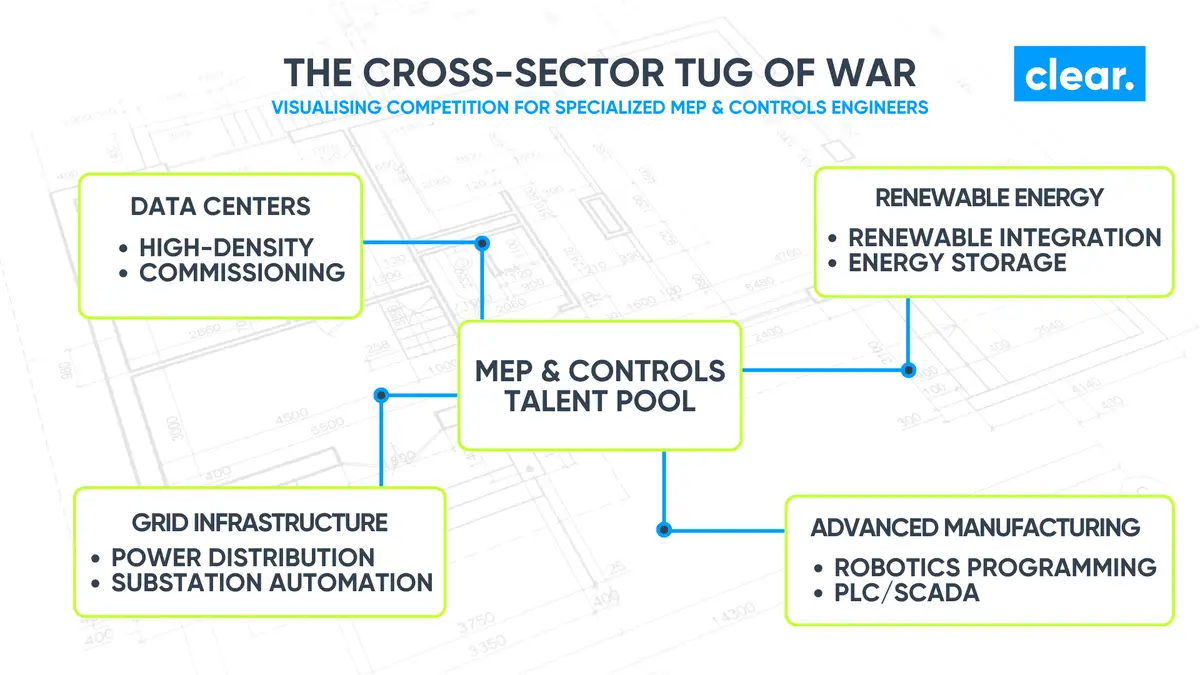
Competition has broadened. Renewable energy developers, grid infrastructure companies, battery storage projects and advanced manufacturing all draw from the same pool of electrical, mechanical and controls engineers. OEMs are watching operators poach their best field service engineers with 20%+ salary premiums. This isn’t a Data Center talent shortage. It’s a cross-sectoral engineering shortage, and Data Centers happen to be at the sharp end of it.
The technical profile has evolved. Liquid cooling, AI-optimised automation, hybrid energy strategies, next-generation power distribution. These aren’t niche requirements any more. They’re standard on hyperscale builds. Finding engineers who understand both legacy systems and next-generation infrastructure is exceptionally difficult.
Geography is a hard constraint. Unlike software engineers, the people who build and commission Data Centers must be physically on site. Every new campus announcement can exhaust a local talent pool overnight. As operators expand into Tier-2 cities and the GCC, they’re hitting thin local pools and the complexity of international mobilisation, visa processing and compliance.
And then there’s the recruiter problem.
The frustration we hear most often, across every buyer persona we work with, is the failure of generalist agencies to deliver. Hiring managers waste hours reviewing CVs from candidates who’ve never set foot on a commissioning site. HR directors manage bloated PSLs where none of the agencies understand mission-critical environments. Programme directors receive contractors who can’t tell a Level 4 script from a site induction pack.
When only 15% of applicants meet minimum qualifications, the ability to access pre-qualified, passive talent through a genuine specialist isn’t a nice-to-have. It’s the only approach that works.
From Capital Commitment to Commissioned Capacity
The organisations winning the talent race aren’t recruiting harder. They’re recruiting differently.
The shift is from transactional recruitment to embedded partnership. A specialist recruitment partner that operates as a genuine extension of the client’s talent function, aligned to programme timelines and capital deployment schedules. Not a supplier of CVs on demand, but a strategic partner who maps workforce requirements against project milestones months before mobilisation begins.
That means pre-qualified talent benches of commissioning engineers, MEP specialists, BMS integration professionals and senior construction leaders who are assessed, engaged and ready to deploy. It means real-time market intelligence on salary benchmarking, regional availability and competitor activity across EMEA, North America and the GCC. It means sourcing from adjacent industries (energy, defence, pharmaceuticals, oil and gas) where engineers hold transferable skills in power systems, environmental controls and complex programme delivery.
And critically, it means a partner with genuine sector credibility. Someone who doesn’t need a commissioning manager role explained to them. Someone who’s placed hundreds of engineers into mission-critical environments and can assess a candidate’s real capability, not just match keywords on a CV.
The organisations converting capital into commissioned capacity fastest are the ones that embedded their recruitment partners earliest.
What This Means for Your Hiring Strategy
If your organisation is deploying capital into Data Center construction, expansion or operations, your workforce plan should be moving at the same speed as your investment plan. If it isn’t, you’ve already got a problem.
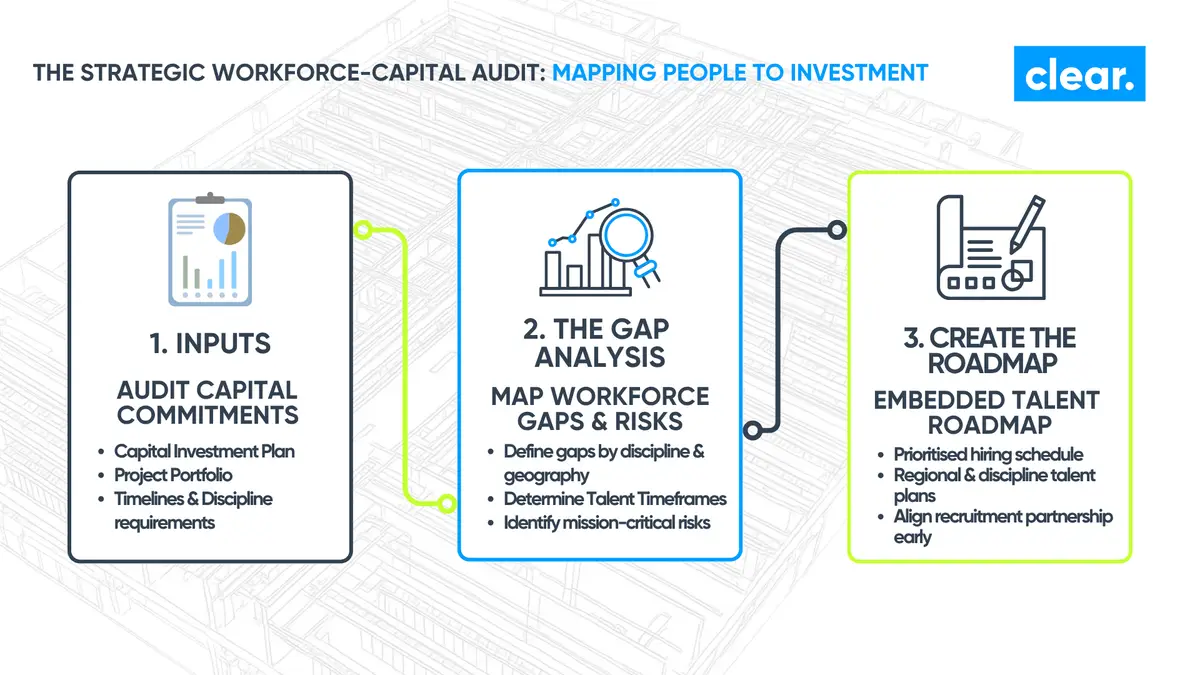
Audit your workforce plan against your capital plan. Map every committed programme against the talent required to deliver it. Identify gaps by discipline, geography and timeline. If your hiring schedule doesn’t mirror your deployment schedule, the programme will suffer.
Engage specialist recruitment before mobilisation, not after. The best candidates are secured months before they’re needed. A partner who understands your programme, your technical standards and your culture will outperform a generalist agency called in at the last minute. Every time.
Demand sector credibility from your suppliers. Ask them to explain the difference between Level 4 and Level 5 commissioning. Ask how many placements they’ve made in Data Center construction in the last 12 months. If the answers are vague, the shortlists will be too.
Build from within, not just from outside. Training academies, apprenticeship pathways, veteran transition programmes and partnerships with educational institutions aren’t optional any more. A third of the workforce is nearing retirement. 40% plan to leave. Organisations that don’t grow their own talent won’t have enough to draw on externally.
Treat retention with the same rigour as recruitment. Competitive pay is table stakes. What differentiates employers in this market is career progression, project quality, leadership culture and a clear sense of purpose. If your people can’t see a future with you, they’ll find one elsewhere.
The Bottom Line
The Data Center investment supercycle is the largest infrastructure build-out in modern history. The capital is committed. The programmes are live.
But none of it gets built without people.
The operators and contractors who align their workforce planning with their capital deployment will convert their commitments into commissioned capacity on time and on budget. Those who don’t will find themselves with sites secured, budgets approved and timelines set, but no one to do the work.
Clear was built for exactly this kind of market. 9 years of exclusive focus on Data Center, power and cooling infrastructure. 160+ placements for operators and contractors including NTT, VIRTUS, Winthrop and Dornan. 83+ placements across power and cooling OEMs. Offices in London, New York and Dubai. A proprietary network of passive engineering talent that generalist firms simply can’t access.
If you’re planning your hiring strategy for the next phase of the build-out, or you’re a specialist professional exploring your next move in mission-critical infrastructure, we’d welcome the conversation.
clear-er.com


