

The US construction industry went into 2026 short around 439,000 workers, most of them skilled trades, and Data Center growth is named as a primary driver. The electrical trades are the sharpest end of it. The US needs something like 300,000 new electricians to meet current demand, and that is before the next wave of campuses breaks ground.
The people who physically build, commission and maintain mission-critical infrastructure are now the most contested hires in the market. And they’re being recruited by everyone. Advanced manufacturing. Renewables. Defence. Battery storage. Grid infrastructure. Data Center developers aren’t competing with each other for these candidates. They’re competing with entire industries.
The operators who’ve recognised this are attracting tradespeople with 25 to 30% pay uplifts, structured career pathways, and something none of the competing sectors can quite match: the chance to work on generation-defining infrastructure.
The Cross-Sectoral Fight for Trades
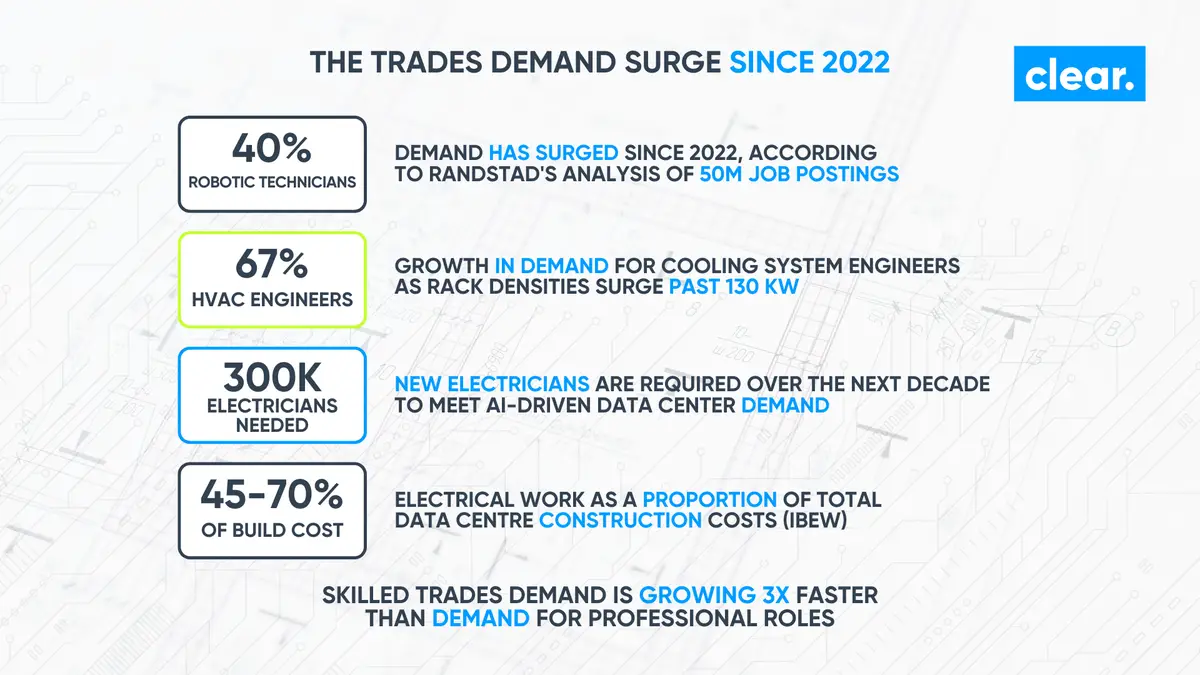
Electrical work accounts for 45% to 70% of total Data Center construction costs, according to the IBEW. The industry needs 300,000 new electricians over the next decade, while 200,000 current electricians are expected to retire. 1 in 5 is already over 55.
But this isn’t a standard labour shortage.
The electrician needed for a hyperscale build in Northumberland is the same electrician a wind farm developer in Scotland wants, a battery storage project in Wales needs, and a pharmaceutical manufacturer in Ireland is trying to retain. The HVAC engineer who can manage precision cooling for high-density AI racks can also manage chillers on a semiconductor fab, environmental controls on a naval vessel, or process cooling on a biotech production line. These are transferable skills, fiercely competed for across every infrastructure sector that’s growing.
For Data Centers specifically, the pressure is compounding. AI projects require 2 to 4 times the workforce of traditional builds. An estimated 340,000 positions could go unfilled by the end of 2026. Only 15% of applicants meet minimum qualifications. And construction is expanding into Tier-2 cities, the GCC and APAC, where local pools are thinner still and the complexity of international mobilisation adds weeks to already stretched timelines.
The real constraint on global tech growth isn’t microchips or capital. It’s the severe scarcity of the specialised talent required to build it.
The pain extends beyond construction. We hear it from power and cooling OEMs constantly. As one service director told Clear: “My best field service engineers keep getting poached by operators who can pay 20% more. I need to backfill quickly, and I need candidates who know our product range, not just generic electricians.” The engineers who leave take product-specific knowledge with them: UPS systems, switchgear, chillers, and BMS platforms. Years of expertise, gone overnight. And when the operator poaching your field engineer also needs 15 more electricians for their next build, the competition is coming from every direction.
How Smart Employers Are Winning
Pay that reflects the reality
Data Center roles routinely pay 25 to 30% more than equivalent positions in conventional construction. Journeyman electricians on hyperscale projects earn approximately $59.50 per hour, translating to $120,000+ annually. With overtime, total compensation can exceed $200,000. In Northern Virginia, the local IBEW chapter took in 615 apprentices this year, up from 510 last year. Membership has doubled in 7 years.
The money is following the demand. But pay alone explains why people show up. It doesn’t explain why they stay.
Career pathways that go somewhere
The most powerful attraction lever isn’t salary. Its trajectory.
The best operators are mapping structured progression: electrician to commissioning, commissioning to technical operations, operations to leadership. From pulling cable to managing the power systems of a 100 MW facility. For mechanical trades: HVAC installation to cooling system design, chiller maintenance to environmental controls management, site-level work to programme-level technical leadership. These pathways didn’t exist in this sector 5 years ago. Now they’re the reason candidates choose one employer over another, even when the pay is comparable.
Engineers don’t leave organisations that invest in their futures. They leave organisations that forget to.
And then there’s the factor none of the competing sectors can replicate.
The infrastructure itself.
A Data Center isn’t a warehouse. It’s one of the most technically complex buildings on the planet. High-voltage power distribution at scale. Redundant UPS systems. Liquid cooling deployments that didn’t exist 3 years ago. Precision environmental controls managing heat loads from AI racks running at 130 kW and beyond.
For a skilled tradesperson who takes pride in the complexity of their work, this is generation-defining infrastructure: the physical backbone of the AI era. Every hyperscale facility commissioned is a permanent mark on the built environment. A building that will house the computing power behind AI applications used by billions of people. That matters to the engineers who build it. It’s a professional pride that a standard commercial fit-out or a temporary construction site simply can’t offer.
The operators who communicate this effectively, who sell the mission as well as the money, are the ones pulling talent away from renewables, defence and manufacturing. The best tradespeople don’t just follow the highest pay slip. They follow the most interesting work.
Sourcing Beyond the Sector
Attraction strategy only works if you can reach the right candidates in the first place. Programme Directors tell us the same thing: they can secure the design team, the project managers, the commissioning leads. But when it comes to the volume of qualified trade professionals needed to physically deliver the MEP package, the pipeline runs dry.
“I have 3 sites mobilising in Q2, and I need 15 commissioning engineers across them. I found out yesterday that 4 of my contractors are finishing and haven’t given me notice.”
A generalist agency posting a job advert won’t reach a mechanical fitter working on a gas turbine who hasn’t thought about Data Centers yet. A specialist partner with a proprietary network of passive candidates will. That’s where Clear operates. Every consultant works exclusively within Data Center, power and cooling infrastructure. We identify electricians and mechanical professionals in adjacent industries who hold directly transferable skills, and we position the Data Center career as the logical next step through direct, relationship-based outreach.
Clear’s Contract & Freelance division deploys pre-vetted trades professionals within days, with a dedicated 3-person delivery team aligned to programme timelines and shortlists typically within 1 to 2 weeks. We’ve made 160+ placements for operators and contractors, including NTT, VIRTUS, Winthrop and Dornan, and 83+ across power and cooling OEMs, including Anord Mardix and Airedale. When the competition for trades is cross-sectoral, sector depth is the only recruiting advantage that holds.
The Trades Will Define Who Delivers
The next 5 years of Data Center construction will be won or lost on one question: who can attract and retain the electricians, mechanical fitters and HVAC specialists needed to commission capacity at the speed the market demands?
Not algorithms.
Not capital.
Hands, tools, and hard-won expertise.
The operators who offer pay that reflects the market, progression that reflects the opportunity, and infrastructure that reflects the ambition will pull ahead. Those who treat trades hiring as an afterthought will find their programmes waiting on the same electricians that 5 other sectors are already bidding for.
clear-er.com


