

AI rack densities are doubling year on year. Traditional air-cooling methods have hit a hard ceiling. And operators across the sector are rapidly adopting direct-to-chip and immersion solutions that can cut cooling-related energy use by up to 60%.
This isn’t a gradual transition. The Data Center liquid cooling market doubled in 2025 to nearly $3 billion and is expected to reach $7 billion by 2029, according to Dell’Oro Group. GPU thermal design power is heading toward 4,000 W per chip. Air cooling, the technology that defined Data Center thermal management for 3 decades, is physically unable to handle what’s coming next.
The technology transition is happening at scale. The workforce transition hasn’t started.
What the sector needs is a new breed of mechanical engineer: one who combines thermodynamics expertise with Data Center operational awareness. And right now, that profile is one of the hardest hires in the market.
Air Cooling Has Hit a Hard Ceiling
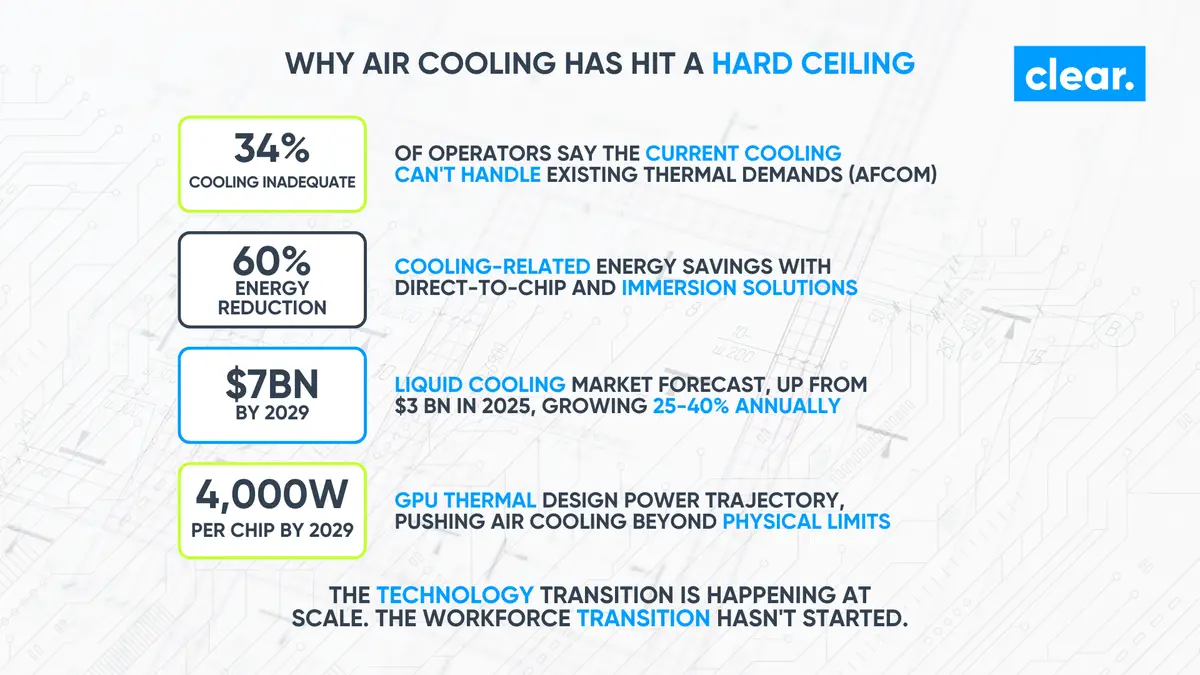
34% of Data Center operators say their current cooling solutions are inadequate, according to the AFCOM State of the Data Center Report. A third of the market, acknowledging that their infrastructure can’t handle the thermal demands they’re already facing.
The physics are straightforward. Air has roughly 3,000 times less heat-carrying capacity than liquid. When racks hit 130 kW and beyond, which is now standard on hyperscale AI builds, the limitations become physical constraints that no amount of airflow optimisation can solve.
Microsoft’s Azure AI clusters, Google’s TPU deployments and Meta’s LLaMA training nodes have all moved to liquid cooling. NVIDIA’s reference architectures for the GB200 NVL72 are designed around liquid-cooled infrastructure as standard. And at GTC 2026, NVIDIA introduced multi-megawatt CDU configurations for its Vera Rubin platform that signal mixed density, hybrid-cooled environments as the new normal.
Liquid cooling has crossed a critical threshold. What was once an optional efficiency upgrade is now a functional requirement for large-scale AI deployments.
The New Breed of Mechanical Engineer
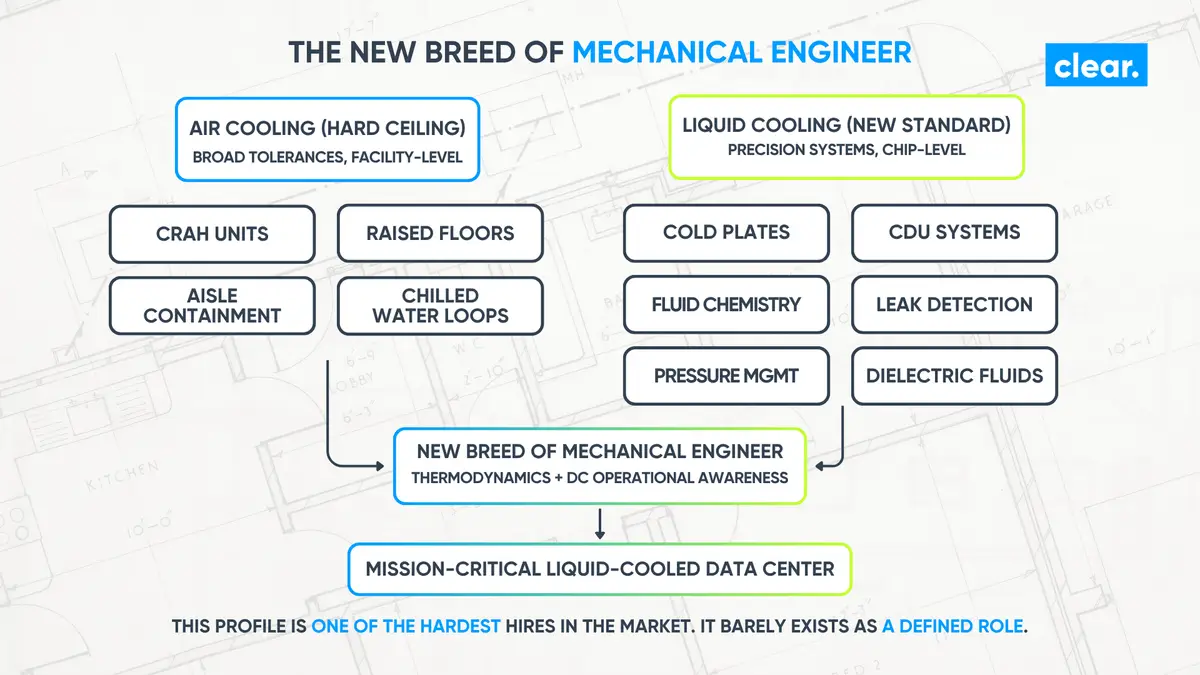
The shift from air to liquid doesn’t just change the equipment. It changes who you need.
Traditional Data Center mechanical engineering is fundamentally about airflow management. CRAH units, raised floors, hot and cold aisle containment, chilled water loops at the facility level. Relatively forgiving tolerances. Broad environmental controls.
Liquid cooling is a different discipline.
Precision fluid systems at the rack level
Direct-to-chip cooling involves cold plates mounted on individual processors, manifolds distributing coolant across racks, and CDUs managing flow rates, temperatures and pressures across the system. This is closer to process engineering than HVAC. Leak detection, fluid chemistry management, pressure differentials across thousands of connection points, thermal behaviour of coolants under varying loads. Cooling is one of Clear’s 3 core sectors, and the shift we’re seeing in the skill requirements for these roles is the sharpest in 9 years of placing engineers into mission-critical environments.
Controls and automation complexity compounds the challenge. Liquid-cooled environments demand tighter BMS integration, real-time flow monitoring and significantly less margin for error. A sensor failure or pressure anomaly can cascade into hardware damage within minutes.
And then there’s commissioning. Programme Directors tell Clear they can get leads for conventional builds. “But when I’m mobilising 3 liquid-cooled sites simultaneously and I need people who can commission an integrated piping system from CDU to cold plate, the pipeline runs dry.” The commissioning sequences, QA documentation and test protocols are fundamentally different. A leak in an air-cooled facility is an inconvenience. In a liquid-cooled facility, it’s a catastrophic risk to millions of pounds of compute hardware.
Where Leading Employers Are Finding Them
The organisations filling these roles fastest aren’t waiting for the pipeline to catch up.
The most direct route is process and chemical engineering. Professionals in pharmaceutical manufacturing, semiconductor fabrication, food and beverage, and petrochemicals already understand precision fluid systems, cleanroom protocols, leak management and flow dynamics at scale. The technical crossover to Data Center liquid cooling is immediate. What they lack is mission-critical context: the understanding that a cooling failure here doesn’t stop a batch. It takes a site offline.
Reaching these candidates requires a specialist partner with networks in both cooling and mission-critical infrastructure. Clear has built long-term relationships with the OEMs at the centre of this transition, including Airedale, Munters and Vertiv, alongside 160+ placements for Data Center operators. That dual positioning is what makes adjacent industry sourcing work: we understand what the candidate can do and what the client actually needs.
Running alongside external sourcing is the upskilling of existing mechanical teams. The best operators are investing in structured programmes that take experienced air-cooling engineers and develop their capability in piping systems, CDU maintenance, cold plate servicing and fluid chemistry. It retains institutional knowledge, builds loyalty, and it’s faster than hiring from scratch. The organisations offering liquid cooling training pathways are keeping their best people. The ones that aren’t are watching them leave.
The OEM ecosystem is creating its own pressure. Vertiv’s liquid cooling revenue more than doubled in 2025. Modine’s Airedale-based cooling division reported 42% Data Center revenue growth. Munters continues to expand its mission-critical portfolio.
All of them need field service engineers, commissioning specialists and technical sales professionals with product-specific liquid cooling knowledge. As one service director told Clear: “I need to backfill quickly and I need candidates who know our product range.” CDU maintenance, cold plate assemblies, dielectric fluid handling. Clear has placed 83+ professionals across these OEMs. The niche is real, and it’s narrowing.
What This Means for Your Hiring Strategy
If your next build includes any liquid cooling component, your workforce plan needs to reflect a fundamentally different mechanical engineering skill set.
Audit your cooling talent against your infrastructure roadmap. Map liquid cooling deployments in your pipeline against the mechanical, controls and commissioning professionals who’ll deliver them. If your plan still assumes air-cooled facilities, it’s already out of date.
Source from adjacent industries with a specialist partner. The mechanical fitter who managed precision cooling in a pharma cleanroom is closer to what you need than a generalist HVAC engineer. But reaching candidates who haven’t thought about Data Centers requires a partner who operates in both worlds.
And invest in upskilling before you lose the people who’d benefit from it. Your best air-cooling engineers already know your facilities, your clients and your standards. Developing them is the fastest path to liquid cooling capability. It’s also the strongest retention lever in a market where 40% of professionals are planning to leave.
The Cooling Transition Is a Talent Transition
Every hyperscale AI facility commissioned from this point forward will include liquid cooling. Every operator expanding capacity is specifying direct-to-chip or immersion. The technology decision has been made.
The workforce decision hasn’t. The new breed of mechanical engineer this transition demands, professionals who combine thermodynamics expertise with Data Center operational awareness, barely exists as a defined hire. The employers who build this capability now will deliver their programmes. The rest will be commissioning liquid-cooled facilities with air-cooling teams.
The technology has left the lab.
The recruitment strategy needs to follow it.
Clear recruits across Data Center, power and cooling infrastructure from London, New York and Dubai. 160+ placements for operators and contractors. 83+ across cooling and power OEMs including Airedale, Munters and Vertiv. If the liquid cooling transition is reshaping your hiring needs, talk to our team.
clear-er.com


