

Amazon, Microsoft, Google and Meta are all investing in small modular reactors to provide dedicated, carbon-free baseload power for their AI campuses. Amazon has tripled its SMR plans in Washington state to 12 reactors producing 960 MW. Microsoft is paying to restart a dormant nuclear plant in Pennsylvania exclusively for its AI infrastructure.
Google has acquired a power company outright. Meta has solicited proposals for up to 4 GW of new nuclear generation. The grid can’t deliver power at the speed the AI build-out demands, and SMRs are the hyperscale’s answer: firm, 24/7, carbon-free electricity that doesn’t depend on weather, fuel markets or utility timelines.
As the first SMR-adjacent Data Center projects target commissioning before the end of the decade, a new category of engineering talent is emerging.
Hybrid engineering talent. Professionals who understand both nuclear safety culture and digital infrastructure. The people who’ll bridge the gap between a nuclear island and a Data Center switchyard. Between NRC regulatory frameworks and mission-critical commissioning protocols.
This role barely exists today. Within 5 years, it’ll define who delivers and who falls behind.
Why This Is a Workforce Problem Now
Nuclear projects have the longest lead times of any infrastructure sector. The DOE’s Energy Workforce Advisory Board has stated that quadrupling US nuclear capacity will require a tripling of the workforce. The IAEA forecasts 4 million new nuclear professionals needed globally by 2050. And 40% of the existing workforce is expected to retire within the decade.
Western nuclear industries also carry a 15-year hiring gap. From the late 1980s to the early 2000s, the sector barely recruited. The people who deferred retirement to cover the gap are now finally leaving.
The nuclear industry isn’t short of talent. It’s short of imagination in how it attracts, trains and supports the workforce of the future.
Now layer the Data Center crisis on top. 51% of operators can’t find qualified candidates. Only 15% of applicants meet minimum qualifications. AI projects require 2 to 4 times the workforce of traditional builds.
Two of the tightest engineering labour markets on the planet are about to converge. Neither has a surplus to lend the other. And the professionals who sit at the intersection of both will command a premium that neither sector has had to pay before.
C-Suite executives at Data Center operators tell Clear they can’t find leaders who combine technical depth with commercial acumen for conventional programmes. Finding leaders who can also navigate nuclear safety culture? That’s a search mandate unlike anything the sector has faced.
What Hybrid Engineering Talent Actually Looks Like
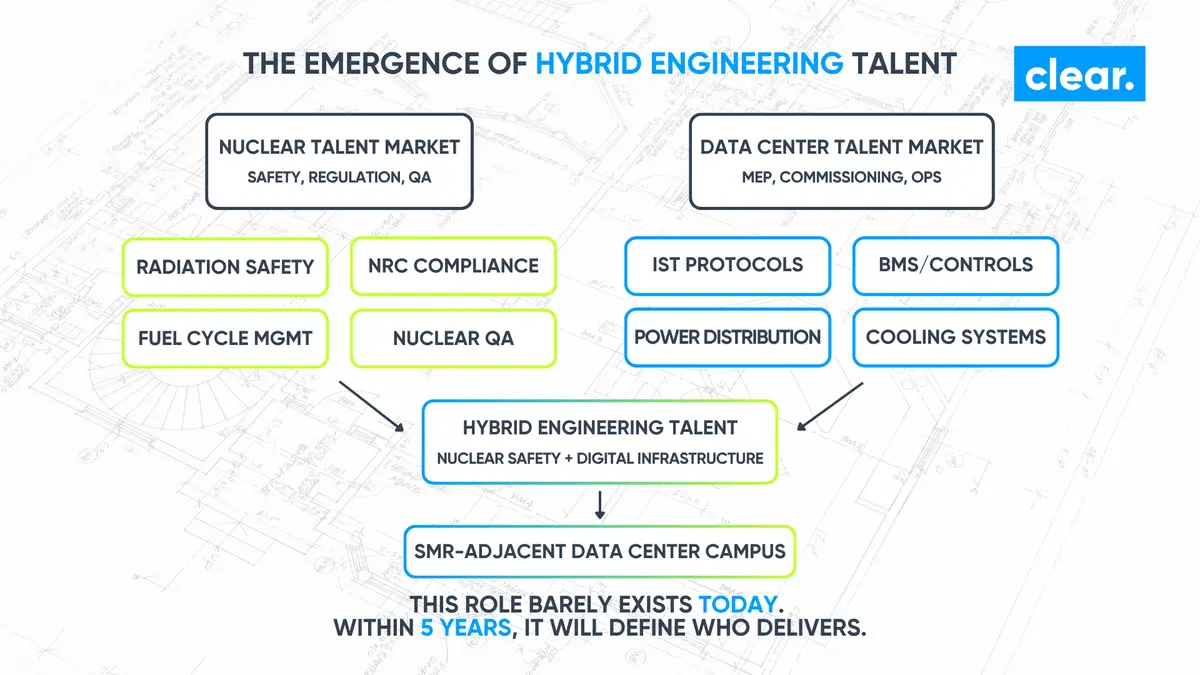
An SMR-adjacent campus doesn’t add nuclear to the job description. It creates an entirely new intersection of disciplines. Clear has spent 9 years placing engineers into mission-critical Data Center environments and alongside energy developers and utilities including Centrica, Vattenfall and Ameresco. That dual positioning is exactly where the SMR convergence sits.
Nuclear safety culture meets mission-critical ops
Radiation protection, fuel cycle management, safety analysis, QA documentation to nuclear standards. These aren’t skills that transfer casually. They take years to develop, carry strict certification and security clearance requirements, and are already competed for by utilities, defence programmes, fusion startups and decommissioning projects.
The dual commissioning challenge
Commissioning an SMR-adjacent Data Center means managing two parallel streams that converge at the power interface. Nuclear commissioning follows its own regulatory regime. Data Center commissioning follows mission-critical protocols. The professional who can bridge both, who understands IST on one side and nuclear QA on the other, is the hybrid engineer the sector needs to develop. And they’re vanishingly rare.
Then there’s the physical campus. Hardened utility corridors. Heat rejection systems sized for long endurance. Security-graded perimeters. Nuclear-grade ground improvement. The trades needed to build these facilities will require nuclear certifications on top of mission-critical experience. Adding nuclear compliance and site security clearance to a market where electricians and HVAC specialists are already the most contested hires in Data Center construction compounds the shortage further still.
For hiring managers, the brief just got harder. “I need someone who can walk onto a commissioning site and add value from day one” is already the most common ask we hear. When that site has a nuclear island on campus, “day one” means a clearance, a certification and a safety culture orientation that most mission-critical engineers haven’t had.
Where the Hybrid Candidates Will Come From
Nobody has a workforce plan for this yet. But the sourcing pathways are becoming visible.
The most immediate route is nuclear-to-Data Center crossover. Engineers in existing nuclear facilities, decommissioning projects, defence programmes and submarine propulsion already understand safety culture, regulatory frameworks and controlled environment operations. Transitioning them requires a recruitment partner who can credibly represent both worlds. Clear’s position across Data Center operators and energy infrastructure clients, including 83+ placements across power and cooling OEMs, gives us that bridging capability.
Running parallel is upskilling from within. Experienced commissioning managers and controls engineers who already operate in mission-critical environments can be trained into nuclear-class standards. The technical gap is smaller than most people assume. The cultural gap is harder. But for professionals who’ve spent years in environments where a single point of failure takes a facility offline, it’s crossable.
Beyond the sector, oil and gas, pharma, aerospace, defence and marine engineering all produce professionals with transferable skills in high-voltage power, precision environmental controls and complex delivery under strict regulatory frameworks. Clear has sourced from these industries for Data Center clients for years. The nuclear layer adds screening requirements, but the fundamental approach is the same. And in the longer term, the organisations that invest in hybrid training programmes and apprenticeships now will be developing the talent everyone else tries to poach in 2030.
What This Means for Workforce Planning Today
SMR-adjacent campuses are targeting commissioning before the end of the decade. Nuclear talent requires security clearances, regulatory certifications and multi-year experience.
The lead time is measured in years, not weeks.
If your organisation’s energy strategy includes any nuclear component, your workforce plan needs to reflect that today. Not when the reactor design is certified. Not when the construction permit is granted. Now. The commissioning engineer you hire today for a conventional hyperscale build may be the same engineer you need in 5 years for an SMR-adjacent campus. Retaining and developing them isn’t just good workforce management. It’s pre-positioning for the next era of infrastructure.
For programmes of this complexity, an embedded recruitment partnership, a dedicated team aligned to programme timelines with market intelligence spanning both nuclear and Data Center disciplines, is the only model that can move at the speed the convergence demands.
A New Category of Infrastructure Demands a New Category of Talent
The convergence isn’t coming. It’s here. The capital is committed. The licensing applications are in motion. The first campuses are in planning.
The talent strategy, for most operators, hasn’t started.
The hybrid engineers this convergence requires don’t yet exist at scale.
Clear operates at the intersection of Data Center, power and energy infrastructure, with 160+ placements for operators and contractors and energy clients including Centrica, Vattenfall and Ameresco. As the sector’s energy strategy evolves toward nuclear, we’re mapping the talent convergence. Talk to our team if the SMR revolution is part of your workforce horizon.
clear-er.com


