

Commissioning engineers are the bottleneck. Not steel. Not switchgear. Not planning permission. People.
Every hyperscale programme, every colocation expansion, every modular build eventually reaches the same point: the facility is physically complete, the systems are installed, and the only thing standing between construction and revenue is a team of engineers who can prove it all works. That team is commissioning. And there aren’t enough of them. With over 23 GW of Data Center capacity currently under construction globally, the scale of the problem is unprecedented.
According to Uptime Institute, 51% of Data Center operators struggled to find qualified candidates in 2024. The biggest gaps were in operations and commissioning roles. Only around 15% of applicants meet minimum qualifications. Positions routinely take over 2 months to fill.
For commissioning, the numbers are worse. The role demands a combination of technical depth, programme awareness and high-pressure decision-making that fewer engineers possess and fewer recruiters know how to assess.
The result is predictable. Programmes slip. Handover dates move. Clients lose confidence. In a sector where the consequences of failure are measured in millions per hour of downtime, the commercial cost of an understaffed commissioning phase lands directly on the operator’s balance sheet.
What Commissioning at Scale Actually Demands
Commissioning a single Data Center is complex. Commissioning 3 or 4 simultaneously, across different geographies, with overlapping programme milestones, is a different discipline entirely.
At facility level, the commissioning engineer is responsible for verifying that every mechanical, electrical and controls system performs as designed. IST, Level 4, Level 5 testing. Integrated systems proving. Failure scenario validation. Each stage has to be documented, witnessed and signed off before the next begins. There’s no shortcut, and there’s no margin for error in a mission-critical environment.
At scale, the challenge compounds. Programme directors are managing commissioning teams across multiple sites, each at a different stage of readiness, each with its own MEP contractor, its own design variations, and its own client expectations. The engineer leading commissioning on a 50 MW campus in Frankfurt needs to apply the same rigour as the one proving a 10 MW colo expansion in Dublin or a new build in the GCC. But the contexts are different, the teams are different, the local talent pools vary enormously, and the pressure is constant.
Commissioning is where construction becomes operation. It’s the highest-stakes phase of any Data Center programme, the point where every system must be proven to perform as designed, and it depends entirely on the credibility of the people running it.
Why the Talent Pool Is So Thin
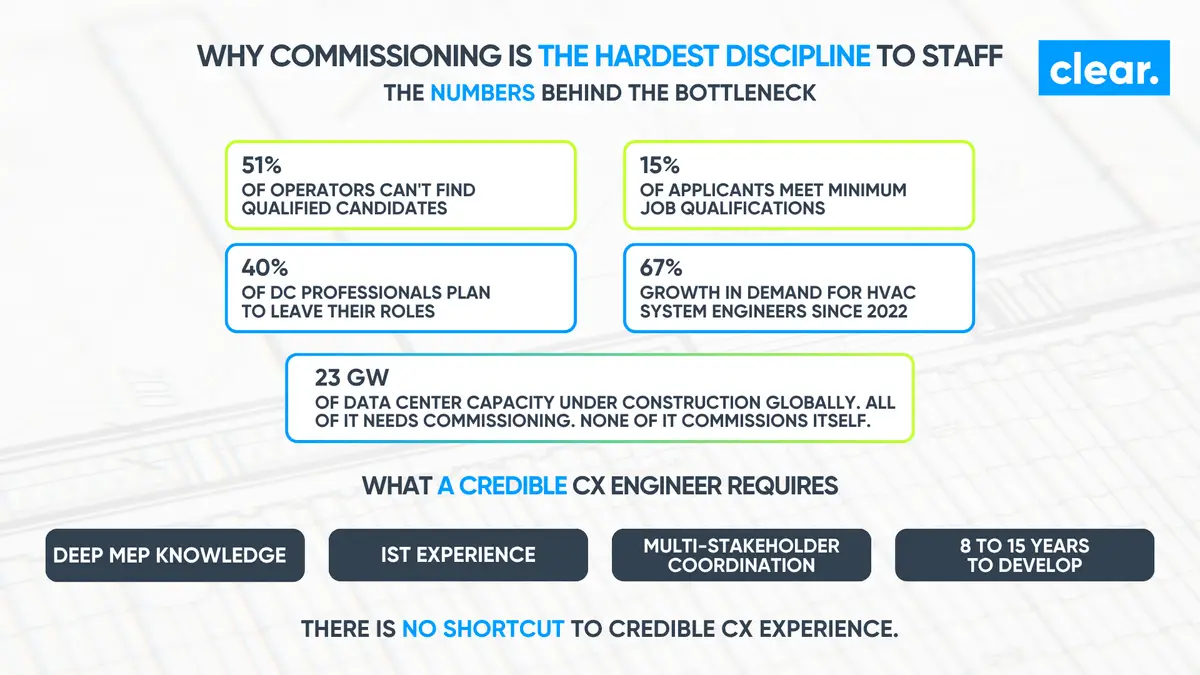
The commissioning talent shortage isn’t simply a volume problem. It’s a profile problem.
A strong commissioning engineer needs deep MEP knowledge, the ability to read and interrogate design documentation, confidence running integrated systems tests under live conditions, and the communication skills to coordinate between the contractor, the operator and the end client. That’s a profile that takes 8 to 15 years to develop. It can’t be fast-tracked, and it can’t be approximated by someone who’s worked in a different sector.
There is no shortcut to credible Cx experience.
Then there’s the retention problem. 40% of Data Center professionals plan to leave their roles, according to industry surveys. Commissioning engineers are among the most mobile. They work project-to-project, they’re constantly recruited, and they know their market value.
Rising salaries alone aren’t stemming attrition. The engineers who stay are the ones whose employers invest in career development, work-life balance and long-term progression, matching roles to where a professional actually wants their career to go, not just the next vacancy on the list. The ones who don’t invest lose people to competitors who do.
A third of the technical workforce is at or nearing retirement age. In commissioning, where expertise is accumulated over decades of hands-on proving, every retirement represents institutional knowledge that doesn’t get replaced by a job advert.
Why Generalist Recruiters Can’t Solve This
This is where the staffing model breaks down.
Commissioning is a discipline that generalist recruitment agencies consistently fail to staff. The reasons are specific. A generalist recruiter doesn’t know the difference between a commissioning manager and a project manager. They can’t assess whether a candidate has genuine IST experience or has simply been on site while someone else ran the scripts. They don’t understand that a Controls and Automation specialist is not interchangeable with a general BMS technician.
The result is what every hiring manager in this sector has experienced: a shortlist of 10 CVs, 2 of which are remotely relevant, none of which have been technically screened against the actual demands of the role. Hiring manager time wasted. Programme timeline unchanged.
HR and TA directors managing agency PSLs see the same pattern from a different angle. Twelve agencies on the list, none delivering consistent quality for specialist commissioning roles. Recruitment spend is high. Hire quality is inconsistent. The PSL review comes around and the question is always the same: who actually understands this sector?
The best commissioning engineers are passive candidates. They’re not on job boards. They’re mid-project, head down, running a proving programme on a live site. Reaching them requires a recruiter who has tracked their career across multiple employers, who knows when their current contract ends, and who has the technical credibility to have a conversation worth their time.
What Hiring Managers Should Be Doing Differently
The commissioning talent crisis isn’t going to resolve itself. AI-driven builds are compressing programme timelines. Modular construction is accelerating handover schedules. Demand for HVAC system engineers has grown 67% since 2022. The pressure on credible Cx professionals is increasing, not easing, and the window between programme award and commissioning phase is getting shorter with every build cycle.
Plan commissioning resourcing at programme award, not at commissioning phase. The single biggest mistake operators make is treating commissioning recruitment as a mobilisation task. By the time the programme reaches IST, the best engineers are already committed elsewhere. Workforce planning for commissioning should begin at the same time as design coordination.
Use a specialist recruitment partner with a passive candidate network. The engineers who will make or break your commissioning programme are not responding to adverts. They’re being identified, tracked and engaged by recruiters who work exclusively in this sector and have built relationships with them over years.
Clear has made 160+ placements for operators and contractors including NTT, VIRTUS, Winthrop and Dornan, and 83+ placements across power and cooling OEMs including Anord Mardix and Airedale. Every engagement is run by a dedicated 3-person delivery team, with technically vetted shortlists typically delivered within 1 to 2 weeks. That network exists because every consultant at Clear recruits within Data Center, power and cooling infrastructure and nothing else.
Invest in your existing commissioning team. The engineer who proved your last facility understands your standards, your clients and your documentation requirements. Developing them into a commissioning lead or programme-level role is faster, cheaper and more reliable than an external hire. It’s also the strongest retention lever available. In a market where 40% of professionals are planning to leave, career development is what keeps your best people from answering the next recruiter’s call.
Build contractor flexibility into your model. Not every commissioning role needs to be permanent. The most effective operators maintain a blend of permanent commissioning leadership and contract engineers who can be mobilised for peak phases. Programme directors managing 3 simultaneous builds in Q2 who discover 4 contractors are finishing without notice need a recruitment partner with real-time visibility of who is becoming available, across multiple sites and geographies. Clear’s Contract and Freelance division exists for exactly this: rapid mobilisation of pre-screened Cx contractors, with the ability to flex resource across a programme as phases overlap.
The Discipline That Defines Delivery
Every Data Center programme is ultimately judged by whether it commissions on time, to specification, and without compromise. The technology is important. The construction is important. But the moment that separates a building from a live, revenue-generating facility is commissioning.
The teams who do that work are the most valuable people in the sector.
They’re also the hardest to find.
Clear recruits commissioning engineers, managers and leadership across Data Center, power and cooling infrastructure from London, New York and Dubai. We deliver into the markets where capacity is being built, not just the markets where candidates happen to live.
clear-er.com


