

The Data Center sector is navigating a £3 trillion investment cycle, accelerating power constraints, tightening regulatory pressure, and a technology transition from air to liquid cooling, from training to inference, from FLAP-D to global distribution. It requires visionary leadership at every level.
And yet, too many C-Suite and VP appointments in Data Center organisations are still based on generic executive search methodologies. Behavioural interviews. Competency frameworks designed for any industry. Shortlists assembled by firms who’ve never placed a commissioning director and can’t distinguish between a candidate who’s delivered a 30 MW colocation build and one who’s led a 100 MW hyperscale AI campus.
Operations management roles have overtaken junior positions as the most expensive to fill in Data Centers, according to the Uptime Institute’s 2025 Global Survey. The hardest vacancy to close is no longer a technician. It’s the person leading the programme.
The blind spot isn’t a shortage of leadership candidates. It’s that the search process most organisations rely on wasn’t built for this sector’s unique combination of engineering complexity, development risk and operational intensity.
Why Generic Search Methodologies Fail Here
Executive search as a discipline was developed for industries where leadership is primarily a commercial and cultural exercise. The methodology evaluates communication, strategic thinking, stakeholder management, board presence. In most sectors, those competencies are sufficient to predict whether a leader will succeed.
Data Centers aren’t most sectors.
The technical credibility threshold
A VP of Engineering at a Data Center operator who can’t walk through a commissioning sequence, who doesn’t understand why a Tier III concurrent maintainability design produces a different operational culture than a Tier IV fault tolerance build, who can’t explain how liquid cooling changes the MEP coordination model, will lose the engineering team’s respect within weeks. Not months. Weeks. In mission-critical infrastructure, technical credibility isn’t a nice-to-have leadership quality. It’s the entry ticket. A generic search process doesn’t test for it because it doesn’t know it exists.
The technical-commercial intersection
The same leader needs to manage a £200 million programme budget, negotiate with hyperscale tenants, report to a board, and make commercial decisions under time pressure where a 3-month delay in commissioning has a specific, measurable cost in uncommissioned capacity against pre-committed leases.
C-Suite executives tell Clear the same thing: “I can find people with technical depth or commercial acumen. Finding leaders who combine both is where every search stalls.” The sector has spent decades promoting technical specialists who can’t navigate commercial complexity, or importing commercial leaders who can’t earn the engineering team’s trust. Both paths produce leaders with a blind spot.
HR and Talent Acquisition Directors describe the operational consequence. They manage PSLs with multiple agencies and measure process performance across all of them. At mid-level, the volume model works. At leadership level, it fails systematically: shortlists look credible on paper, hires unravel within 6 months because the candidate’s experience was at the wrong scale or without the commissioning context the role demands.
A competent generalist can run a programme in any sector. A high-performing Data Center leader navigates the specific intersection of engineering complexity, development risk and operational intensity that no other infrastructure type demands.
The Assessment Criteria That Separate Sector Leaders from Competent Generalists
Here’s what Clear’s 160+ placements across operators and contractors including NTT, VIRTUS, Equinix, Vantage, Aligned, Winthrop and Dornan have taught us about what separates the candidates who succeed from the ones who look good in the boardroom but struggle on the programme.
Mission-critical fluency. Can the candidate articulate why a single point of failure in a 2N redundant path is not just a design issue but an operational culture issue? Do they understand the commercial consequence of a Cx delay on a facility with pre-committed capacity? This isn’t about reciting specifications. It’s about whether they think in mission-critical terms. Leaders who do this naturally earn their team’s credibility. Leaders who don’t get exposed the first time they walk a live site.
The second criterion is programme-specific delivery experience. Not “infrastructure leadership.” What power density? What cooling technology? What tenant type? A candidate who delivered a 30 MW colocation build may be completely wrong for a 100 MW hyperscale AI campus with liquid cooling and 130+ kW racks.
Then there’s the ability to build and retain a team in a poaching market. Roughly 25% of Data Center staff departures in 2026 are professionals being hired away by competitors. When a senior leader leaves or fails, the team they built becomes vulnerable. The commissioning manager who joined because of that leader’s reputation. The controls engineer who relocated for the programme. A high-performing Data Center leader doesn’t just deliver the current programme. They create the gravitational pull that attracts and holds the team the next 3 programmes need.
And finally, navigation of the current convergence. Power constraints, regulatory pressure, the shift to liquid cooling, the move from training to inference workloads, expansion into Tier-2 markets. The leader this sector needs right now isn’t someone who can manage a stable environment. It’s someone who can navigate a sector that’s changing faster than at any point in its history. That means comfort with ambiguity, the ability to make decisions with incomplete information, and the technical depth to understand the implications of those decisions across every discipline.
Getting the Search Right
Leadership hires now take 60 to 90 days to close. In a market where the best candidates are fielding 2 to 3 competing offers simultaneously, the search process itself becomes a competitive variable.
The organisations closing leadership hires fastest are starting the search months before the role opens, during site design and equipment procurement rather than at mobilisation. A commissioning director hired during the design phase shapes the programme. One hired 3 months into construction inherits problems they didn’t create.
They’re also engaging a specialist search partner who doesn’t need the sector explained. Clear operates retained search for Data Center, power and cooling leadership from London, New York and Dubai. At the leadership level, every mandate is handled by a dedicated 3-person delivery team with direct senior involvement, not delegated to junior researchers. We’ve placed leadership across operators including NTT, VIRTUS, Equinix, Vantage and Aligned, and across contractors including Winthrop and Dornan.
Our biannual salary benchmarking across Data Center and energy disciplines means we calibrate compensation on the first approach. In a market where leadership candidates are fielding 2 to 3 competing offers, presenting a competitive package without negotiating upward after losing preferred candidates saves weeks.
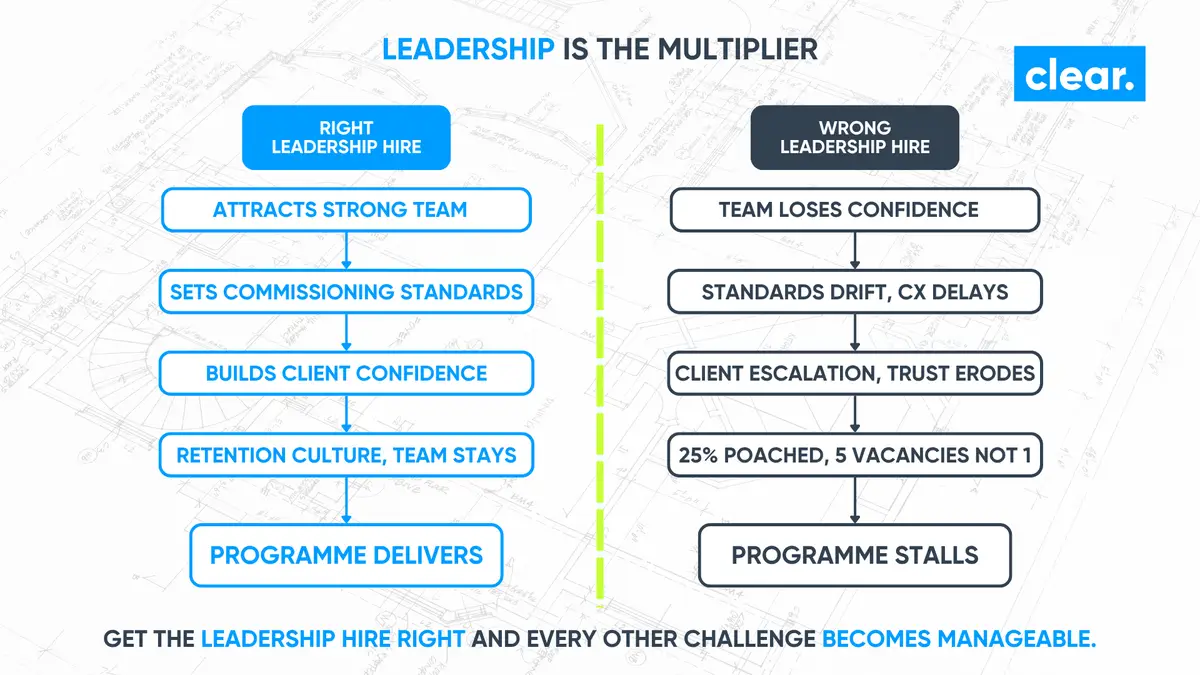
Leadership Is the Multiplier
Every piece in this series has identified a specific workforce challenge. Each one becomes significantly harder when the leader responsible for solving it isn’t right for the role. And significantly easier when they are.
A great engineering director doesn’t just fill a vacancy. They attract a team, set commissioning standards, build client confidence, and create the operational culture that retains professionals in a market where 40% are planning to leave.
The blind spot isn’t that the candidates don’t exist.
It’s that the search methodology wasn’t designed for this sector.
Fix the process, and the leadership follows.
Clear’s retained search capability spans Data Center, power and cooling leadership across EMEA, North America and the GCC. If your next leadership hire is programme-critical, talk to our team.
clear-er.com


