

Microsoft runs an 11-week Military Data center Pathway that takes transitioning service members and turns them into critical environment technicians. Nearly 750,000 veterans already work in the US energy workforce. The DOE reports they make up 9% of the national clean energy sector, nearly double their share of the overall economy.
The crossover isn’t a future trend. It’s already happening.
And it needs to happen faster. 51% of Data Center operators can’t find qualified candidates. Only 15% of applicants meet minimum qualifications. AI projects require 2 to 4 times the workforce of traditional builds. The talent the sector needs isn’t going to come from within its own ranks. There aren’t enough mission-critical engineers in the world.
The talent is in adjacent industries: defence, oil and gas, renewables, pharmaceutical manufacturing, marine engineering, aerospace. Professionals with transferable competencies in high-voltage systems, mission-critical operations and programme delivery. The skills are real. But making the crossover work at scale requires a targeted approach to assessment and onboarding that most operators haven’t built yet.
Which Transferable Skills Translate Most Effectively
Not all adjacent industry skills transfer equally. Clear has been sourcing from adjacent industries for 9 years, placing engineers from energy, oil and gas, pharmaceuticals, defence and manufacturing into mission-critical environments. Here’s where the real equivalences sit.
Defence and military
The strongest crossover is safety culture and controlled environment operations. Service members operate where procedural compliance is the operating standard, not a preference. The HVAC technician who maintained environmental controls on a naval vessel understands mission-critical cooling. The electrical engineer who managed power distribution on a military base understands redundancy and failover.
Physical security awareness, equipment maintenance under strict protocols, team discipline, operating complex systems under pressure: all transfer directly. The development gap is narrower than it looks. Data Center terminology (IST, Level 4 scripts, BMS architecture), commissioning documentation standards, and the commercial context where downtime is measured in revenue rather than incident reports. Teachable within a structured 4 to 8-week onboarding programme.
Oil and gas
The most underappreciated talent pool in the sector. Process engineers managing high-pressure fluid systems. Electrical engineers operating HV distribution in hazardous environments. Controls engineers managing SCADA and real-time monitoring across distributed sites.
An oil and gas process engineer often understands fluid dynamics at a level that exceeds what most Data Center mechanical engineers bring. That’s directly relevant to liquid cooling, which is now a functional requirement on hyperscale AI builds. High-voltage power systems knowledge, precision instrumentation, zero-tolerance compliance culture: all directly transferable. The gap is context, not capability. The shift from production uptime language to availability and redundancy language is bridgeable in weeks, not months.
Renewables professionals are the fastest-growing crossover pipeline, and the one where Clear’s dual positioning is most visible. Solar and wind project engineers manage complex electrical installations under grid compliance requirements. Battery storage specialists understand power systems, switchgear and BMS integration. The technical crossover is direct. The development need is the step change in operational rigour between a distributed generation site and a centralised mission-critical environment, plus familiarity with specific OEM product ranges. Clear’s energy clients include Centrica, Vattenfall and Ameresco. We recruit across the energy value chain, which gives us direct visibility into which engineers hold the competencies Data Center clients need.
The Data Center workforce of the future won’t come from the Data Center sector. It’ll come from the industries that built the engineers the sector needs.
How to Assess Cross-Sector Candidates
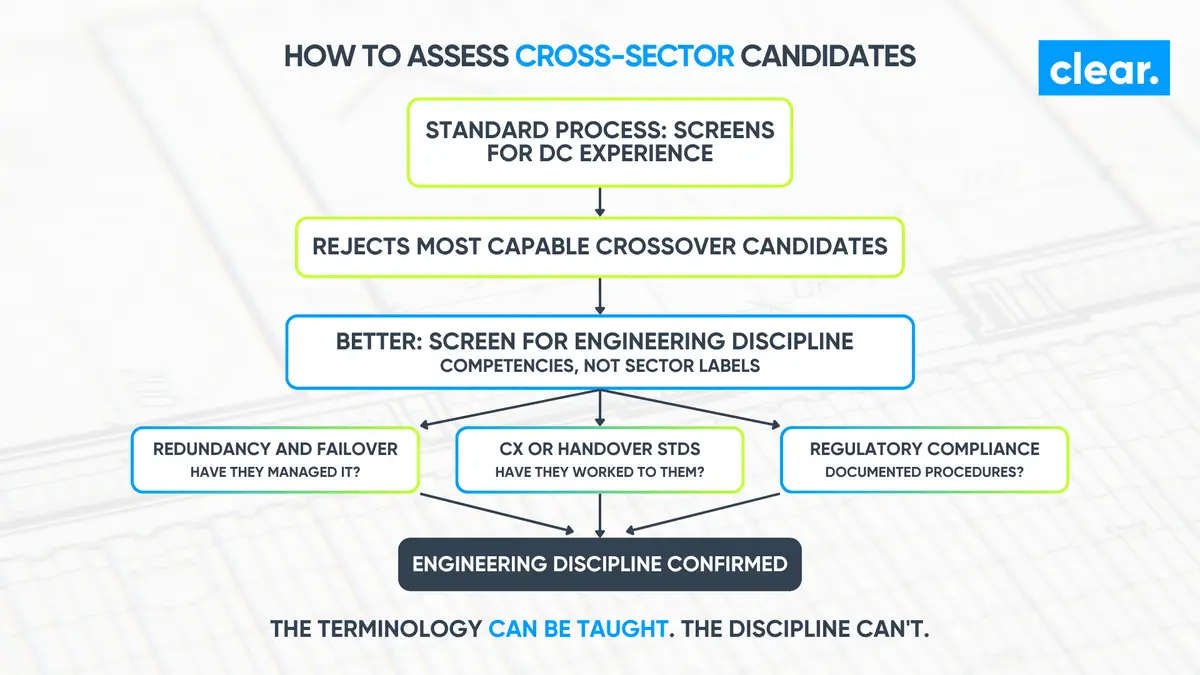
The standard hiring process systematically rejects the most capable crossover candidates. It screens for sector-specific terminology, familiar employer names and role titles that match the spec. An oil and gas process engineer with 15 years of HV power systems experience gets filtered out because the CV doesn’t say “Data Center.”
Hiring managers tell Clear the same thing: “I need someone who can walk onto a commissioning site and add value from day one.” For crossover candidates, “day one” readiness looks different. It’s about underlying engineering discipline, not abbreviations.
Start with specifications. If the role requires high-voltage power distribution knowledge, say that. Don’t say “5+ years Data Center experience.” The engineer who managed HV distribution on an offshore platform has the competency. They don’t have the label. Screening for the label excludes them. Screening for the competency identifies them.
In interviews, the questions that matter for crossover candidates aren’t terminology tests. They’re discipline tests. Have they managed systems with redundancy and failover? Have they worked to commissioning or handover standards? Have they operated under documented regulatory compliance frameworks? These questions reveal whether the candidate has the engineering rigour mission-critical environments demand. The terminology can be taught. The discipline can’t.
This is also where a specialist recruitment partner earns their value. A generalist recruiter can’t evaluate whether a submarine power systems engineer’s experience translates to a Data Center HV role. Clear’s consultants work exclusively within Data Center, power and cooling infrastructure. When we present a crossover candidate, we’ve already assessed the transferable competencies, identified the development areas, and framed the experience in language the hiring manager recognises.
Our biannual salary benchmarking across both Data Center and energy disciplines also helps set the compensation correctly, making the crossover financially compelling for the candidate without overshooting the market.
The Onboarding That Makes Crossover Hiring Stick
Sourcing and assessing crossover candidates is half the equation. The other half is their first 8 weeks.
The technical skills transfer. The operational context doesn’t. A defence engineer needs commissioning sequences, handover documentation and BMS architecture. An oil and gas engineer needs to translate production uptime into availability and redundancy. A renewables engineer needs the operational rigour step-change. For candidates moving into OEM roles, there’s product-specific knowledge: CDU configurations, cold plate assemblies, specific switchgear platforms.
Programme Directors tell Clear this is where the return on crossover hiring is won or lost. “The crossover hires who get structured onboarding are outperforming sector-native engineers within 6 months. The ones who don’t get it are struggling at 3 months and leaving at 9.”
The operators with the highest crossover retention rates invest in targeted 4 to 8-week technical programmes. Not generic corporate inductions. Structured bridging that maps existing competencies against mission-critical knowledge gaps and delivers the gap training in a compressed, practical format. The investment is modest. The cost of a failed crossover hire, or a 3-month vacancy on a live programme, is not.
The Crossover Is the Future of Data Center Recruitment
Every blog in this series has touched on adjacent industry sourcing. The £750 billion build-out, the liquid cooling transition, the SMR convergence, the Tier-2 expansion, the inference shift. In every case, the sector’s ability to deliver depends on engineers it can’t produce from within.
This is the piece that puts it together. Defence professionals with safety culture and controlled environment experience. Oil and gas engineers with high-voltage power and precision systems expertise. Renewables specialists with grid compliance and electrical commissioning skills. The talent exists. The transferable competencies are real. What’s been missing is the assessment rigour and onboarding infrastructure to make the crossover work at scale.
The organisations that build it will staff their programmes. The ones that keep screening for “Data Center experience” will keep rejecting the most capable candidates in the market.
The talent crossover isn’t a backup plan.
It’s the plan.
Clear recruits across Data Center, power and cooling infrastructure from London, New York and Dubai. 160+ placements for operators and contractors. 83+ across power and cooling OEMs. Energy developer and utility clients including Centrica, Vattenfall and Ameresco. Our cross-sector positioning is what makes adjacent industry sourcing work at the scale the sector needs. Talk to our team.
clear-er.com


