
Two job titles turn up constantly in Data Center hiring and they get treated as the same thing. They are not remotely the same thing, and confusing them is the most common reason a good engineer applies for the wrong role.
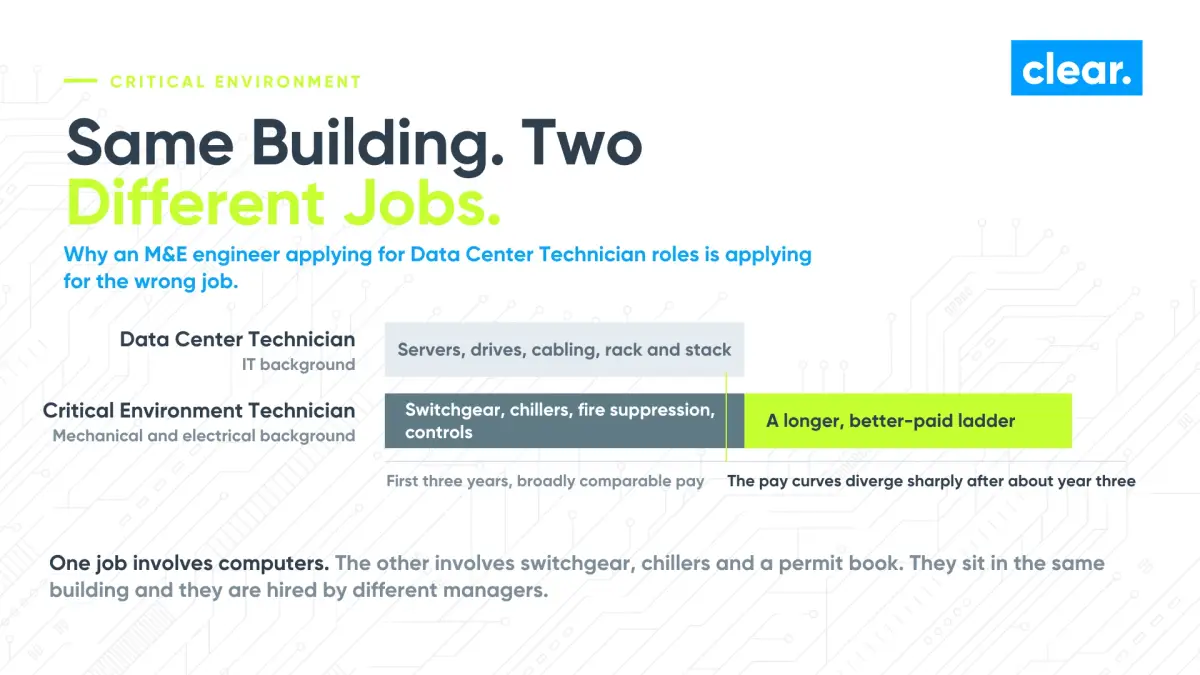
A Data Center Technician looks after IT hardware and network infrastructure. Servers, drives, cabling, rack and stack, decommissioning. The background is IT.
A Critical Environment Technician looks after the plant that keeps the building alive. Electrical distribution, mechanical systems, HVAC, cooling, fire suppression, controls, and the pipework and machinery around them. The background is mechanical and electrical.
One job involves computers. The other involves switchgear, chillers and a permit book. They sit in the same building, they are hired by different managers, and the pay curves diverge sharply after about year three.
If you have an M&E background and you have been applying for Data Center Technician roles, this is very likely the article you needed.
What the job actually involves
A Critical Environment Technician is responsible for the installation, repair and maintenance of the electrical, mechanical and piping equipment, machinery and controls throughout a facility. Alongside that sits continuous monitoring: power, cooling, HVAC, fire suppression and building systems performance, with the explicit purpose of preventing downtime.
In practice a shift splits three ways. There is planned preventative maintenance, which is the bulk of it and runs to a schedule and a method statement. There is monitoring and response, watching the BMS and the power monitoring system and reacting when something moves outside its envelope. And there is escorting and supervising, because on a live floor a great deal of contractor work cannot happen without a competent person from the operations team standing with it.
The environment is 24 hours a day, every day of the year, so the rota is rotating shifts including nights and weekends. That is not a scheduling detail you can negotiate around. It is structural, because the load never stops.
The consequence structure is what makes the role different from general building maintenance. On a commercial site a mistake is an inconvenience. Here it is measured in the hourly value of the load you dropped, and everything about how the work is organised, the permits, the isolations, the second person, the documentation, follows from that.
Who employs them, and why that matters more than you think
Three quite different employer types, and candidates routinely fail to distinguish between them.
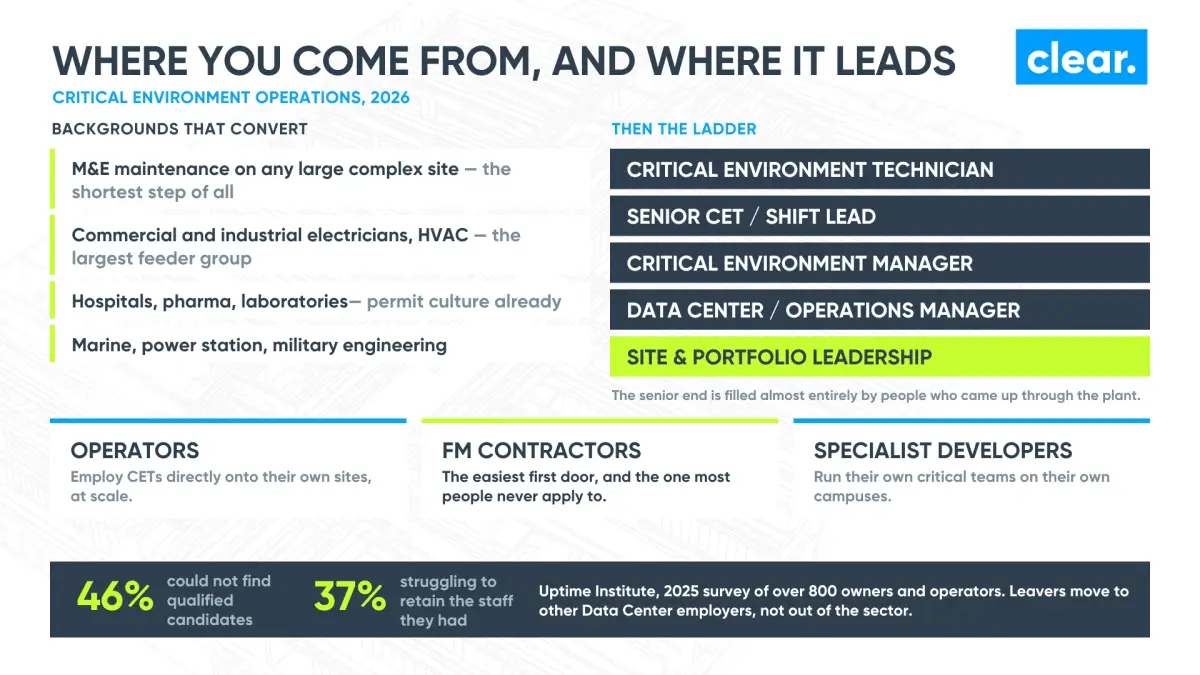
Operators employ CETs directly onto their own sites. Microsoft is the most visible example, running the role at scale across its estate.
Facilities management contractors employ them onto client sites under an operations contract. JLL is a large one. You are employed by the FM firm and you work on someone else's Data Center.
Specialist Data Center operators and developers sit somewhere between, running their own critical teams on their own campuses.
The reason this matters: the FM contractor route is by a distance the easiest first door into critical environment work, and most people trying to break in do not apply there because they have never heard of the employer. Two years with an FM contractor on a live Data Center gives you exactly the experience an operator will hire you for directly, usually at a meaningful pay increase.
The backgrounds that convert
The role wants a solid electrical, mechanical or HVAC foundation, evidenced by technical qualifications or equivalent time served. Beyond that the entry routes are wider than the adverts suggest.
Building services maintenance engineers convert well, particularly anyone who has covered hospitals, pharmaceutical sites or laboratories, because those are also critical environments with a permit culture and a low tolerance for improvisation. Marine engineers and power station technicians convert extremely well for the same reason, and are often surprised at the pay comparison once travel is stripped out. Military engineering and technical trades convert well and are actively targeted by several operators.
Electricians and HVAC engineers from commercial and industrial work are the largest single feeder group, and the shortest step of all is from an M&E maintenance role on any large complex site.
What does not convert is a pure IT background, which brings us back to the confusion at the top of this article. An IT technician applying for a Critical Environment Technician role is applying for a job in a different discipline. Not a harder one or an easier one, a different one.
Where it leads
The ladder is short, well defined, and it is the reason the role is worth taking seriously rather than treating as a stopgap.
From Critical Environment Technician you move to Senior CET or Shift Lead, supervising a team of engineers across a shift, acting as the technical point of contact, and owning both planned and reactive work while keeping the site up. From there the routes are Critical Environment Manager, Data Center Manager, Operations Manager and ultimately site or portfolio leadership.
That progression is visible in how technical operations hiring actually works. The roles we are asked to fill run from shift leadership through operations management and Data Center management to directors and vice presidents. The senior end of that ladder is filled almost entirely by people who came up through the plant, because you cannot credibly run a critical site without having stood on the floor at 3am when something failed.
There is also a sideways move worth knowing about. CETs with strong controls exposure move into automation and controls and commissioning work, which pays differently and travels differently. Several of the best commissioning engineers I work with started on an operations rota.
The market position, in plain terms
Uptime Institute surveyed over 800 Data Center owners and operators in 2025. 46% could not find qualified candidates for open roles. Around 37% were struggling to retain the staff they had. Close to two thirds reported one problem or the other.
The detail worth understanding as a candidate is where the leavers go: overwhelmingly to other Data Center employers rather than out of the sector. People are not leaving because the work is bad. They are moving because someone offered more money or a better rota, and the sector has been bidding against itself for several years.
That is a good market to be a competent, reliable, qualified operator in. It is a very good market to be one with high voltage authorisation in.
What gets people rejected
Four things, in the order I see them.
Applying with an IT CV. Covered above, but it is the biggest one by volume. If your experience is servers and networks, this is not your role.
Not naming the plant. "Maintained building systems" tells a hiring manager nothing. Name the switchgear, the UPS, the generators, the chillers, the CRAH units, the BMS platform. Specifics are the whole currency here.
No evidence of permit discipline. Describe the safe systems of work you have operated under, the isolations you have carried out, the permits you have held. Engineers who lead with their resourcefulness and initiative are describing exactly the trait that worries an operations manager. Lead with your discipline instead.
Vagueness about shifts. The rota is not negotiable, so ambiguity reads as a no. Say plainly what pattern you will work.
If this is the job you actually wanted
The short version: if you hold an electrical, mechanical or HVAC background and you have been reading Data Center career advice aimed at IT technicians, you have been reading the wrong material. The role that fits your experience pays better over time, has a clearer ladder, and is harder for employers to fill.
Rewrite your CV around plant, permits and criticality. Apply to the facilities management contractors as well as the operators. Get clear on your shift availability before the first call rather than at offer stage.
Our live vacancies are filterable by discipline, so you can see what critical environment and operations employers are asking for right now. If you want to work out where your background actually fits, our team is split by discipline and region, so you will speak to someone who works this market rather than a generalist.