

The building is no longer the bottleneck. Not the steel, not the switchgear. The grid connection.
For most of the last decade, a Data Center programme lived or died on construction. Secure the land, line up the contractors, pour the concrete, and the schedule held. That logic is broken. A general contractor can raise a shell, install the electrical rooms, and reach commissioning faster than the client can finalise its connection to the grid. The box is ready. The power isn’t.
The industry has a name for the gap: time-to-power. Most operators still treat it as a power problem. It’s a talent problem wearing a power problem’s clothes, and the people who solve it are the scarcest hires in the sector.
The grid connection is now the schedule
Start with the demand, because the scale is what broke the old sequencing. The IEA projects that global Data Center electricity consumption will more than double to around 945 TWh by 2030, up from roughly 415 TWh in 2024. That 2030 figure is more than Japan’s entire electricity consumption today. The US accounts for the largest share of the growth, China next, and together they make up close to 80% of it.
Any grid would strain under that. What makes it acute for Data Centers is concentration. One AI campus can request hundreds of megawatts in a single location, on a timeline measured in months, from a transmission system designed around years.
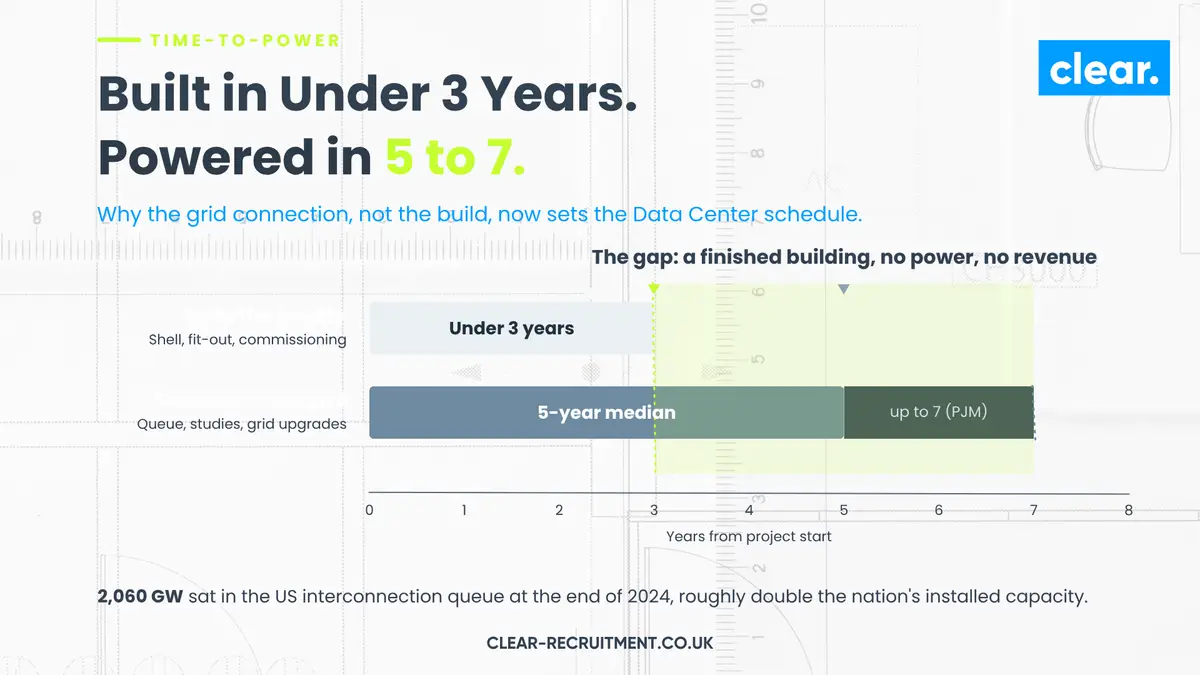
The clearest measure of the problem is the interconnection queue. Lawrence Berkeley National Laboratory’s Queued Up research found around 2,060 GW of generation and storage seeking connection to the US grid at the end of 2024, roughly double the country’s entire installed capacity. The typical project now waits about 5 years from application to commercial operation, up from under 2 years in 2008.
5 years is the median. In the worst regions it runs longer. Analysis of the PJM territory, which covers much of the Data Center heartland, points to waits approaching 7 years for the largest load filings.
Do the maths. If you can build a facility in under 3 years and the power takes 5 to 7, the grid connection isn’t a delay to your schedule. It is your schedule.
Regulators are moving, and every move adds a layer to manage rather than removing one. FERC has issued show-cause orders to the 6 largest US grid operators, directing them to defend or rewrite their interconnection rules for gigawatt-scale loads, according to Data Center Knowledge. Virginia introduced a consumption tax on Data Center electricity from 1 July 2026. In mid-July, Reuters reported the White House planned to convene utilities and developers around a voluntary pledge to stop AI power demand from raising household bills. Each shift changes how a connection gets approved, financed, and defended. Each one raises the value of people who can navigate it.
The people who unlock power aren’t the people who build it
This is the part most hiring plans miss.
Operators have spent years fighting over commissioning engineers, MEP project managers, and critical-environment technicians. Those roles are still hard to fill. But the discipline that now sets the completion date sits upstream of all of them, in the electrical and grid-facing engineering layer, and most companies aren’t resourcing for it until the schedule is already exposed.
The roles that decide time-to-power include substation and high-voltage design engineers, who design the connection assets that tie a campus into the transmission network. Grid connection and interconnection managers, who own the utility relationship and keep the application moving through study after study. Power systems engineers with load-flow, protection, and short-circuit modelling experience, who prove the connection will hold before it is energised. Protection and controls engineers for high-voltage systems, a pool that has always been thin. And utility and regulatory liaison specialists, who now need to speak FERC dockets, state tariffs, and ratepayer politics as fluently as they speak engineering.
A strong Data Center project manager can’t step into a substation protection role. The training path is long, the qualified population is small, and most of it sits inside utilities, transmission operators, and the renewables sector rather than on the Data Center side. So when a programme director loses a grid-connection lead at short notice, they aren’t filling a vacancy. They’re exposing a milestone, and usually the one the board is already asking about.
Why the shortage won’t fix itself
Three forces are squeezing this pool at once, and none of them respond to a bigger salary.
Advertising doesn’t reach these people. Across Data Center roles, only around 15% of applicants meet the minimum qualifications, a pattern we see again and again in specialist engineering searches. The best high-voltage and grid engineers aren’t on job boards. They’re employed, busy, and reachable only through a direct relationship built before you need them.
The expertise is also retiring out. Close to a third of the technical workforce in critical infrastructure is at or nearing retirement, and in North America the over-55s already outnumber the under-30s. The engineers who have connected large loads to a transmission network before are the exact cohort walking out of the door.
And the whole energy transition is bidding for the same names. Renewables developers need these substation and grid-connection engineers to bring wind and solar online. Transmission operators need them to run the queues they’re now being told to reform. Even the ones you find are hard to hold. Uptime Institute found that around half of Data Center operators struggled to source qualified candidates, and pay rises alone aren’t stopping people leaving for better work.
The shape of the problem changes by market, too. The US RTOs each run their own queue, with PJM and ERCOT under the most pressure. Europe’s FLAP-D hubs face transmission congestion and planning friction, while the Nordics open new ground with new grid limits. The GCC brings its own mobilisation dynamics. A hyperscaler building across several of these at once doesn’t want a different local agency in each. It wants one partner accountable for the same scarce roles wherever the next campus lands.
Hire before the award, not after the slip
Treat grid and high-voltage talent as a front-end decision, level with land and power. Map the market before you need it. Know where these engineers sit and what would move them. Warm the relationship early, so the name is ready when the project is awarded, not cold when the schedule is already slipping.
That’s the part we’re built for. Clear has recruited exclusively in Data Center, power and cooling since 2017, and that focus is a network of passive engineers who never answer a job advert. It is the same reason retained and executive search works differently in this sector than it does anywhere else. We’ve placed more than 160 engineers across NTT, VIRTUS, Winthrop, and Dornan, and 83 more across power and cooling OEMs like Anord Mardix and Airedale. We know who the grid-connection people are, where they work now, and what it takes to move them.
If time-to-power is the risk on your programme, talk to our Power and Cooling desk before the queue, not after the slip.


