

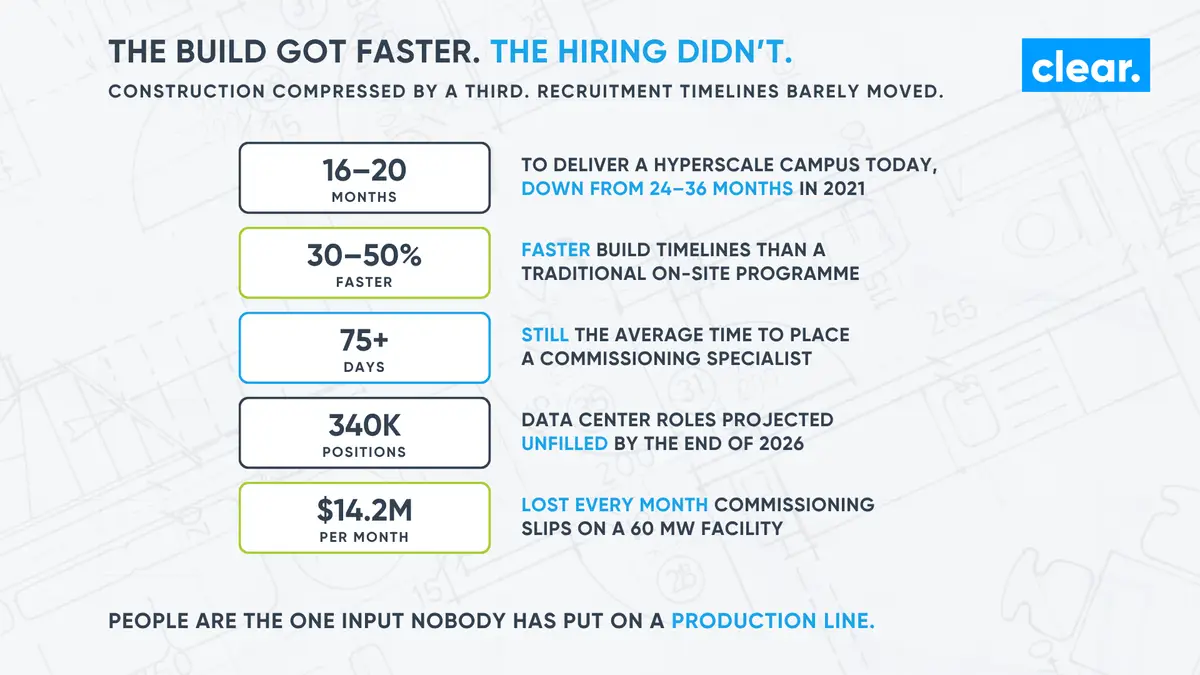
A hyperscale campus that would have taken three years to deliver in 2021 can now be online in 16 to 20 months. Some operators are beating that. Power skids, cooling assemblies and entire white-space modules turn up on site pre-built and pre-tested, and the on-site programme that used to run 36 weeks has been squeezed to roughly 16.
The build has been industrialised. The hiring hasn’t.
We place engineers onto these programmes for a living, and the mismatch is the first thing main contractors raise on a call now. They’ve re-engineered the build. They’re mobilising against a schedule that quietly assumes the people will be there on the day. People are the one input nobody has managed to put on a production line.
That gap, between how fast a Data Center can now be built and how slowly the workforce behind it still gets hired, has turned into a commercial risk that lands directly on the delivery date.
The build programme got re-engineered
Modular and prefabricated construction has moved from the edge of the sector to the centre of how large Data Centers get delivered. Factory-built modules take weather, trade-stacking and on-site rework off the critical path, and modular approaches are slashing deployment time against conventional methods. Delivery windows that ran 24 to 36 months now commonly land between 16 and 20, a 30 to 50% compression on a traditional build.
Digital twins took out the coordination lag next. Change one parameter and the model recalculates electrical loads, flags the cooling knock-on and notifies the right engineers in minutes, work that used to take a team weeks. PM Group ran augmented reality through the design and build of one of Europe’s largest hyperscale campuses in Denmark and reported real time and labour savings.
The result behaves more like a manufacturing line than a building site. Order to energisation, in the most aggressive cases, in months.
Recruitment didn’t get the memo
Now look at how the workforce behind that programme still gets hired.
Time-to-hire for the specialist roles has barely moved in years. Commissioning specialists, the people who decide whether a billion-pound campus energises on schedule, routinely take more than 75 days to place through a conventional search. A generalist agency matches keywords against established job titles and sends back CVs that read right and don’t survive a technical screen.
The pool is shrinking under the demand at the same time. The US construction industry went into 2026 short around 439,000 workers, most of them skilled trades, with Data Center growth named as a primary driver. And the shortage is one of qualified people rather than of bodies: Uptime Institute’s 2025 survey of more than 800 operators found 46% could not find qualified candidates for the roles they had open. The US needs something like 300,000 new electricians to meet current demand, and electricians are precisely the trade contractors name first when you ask what’s holding them up.
It’s an ageing workforce too. More than one in five US construction workers were over 55 in 2024, and plenty are choosing to retire rather than gear up for a boom. Scarcity in the skilled trades pushed Data Center construction labour costs up 8 to 12% year on year across primary North American markets, according to Turner & Townsend’s Data Center Cost Index.
So one half of the equation has compressed by a third or more. The other half has, if anything, got slower and dearer.
The gap is where the schedule risk now lives
Compress one side of an equation and not the other, and the slack has to go somewhere. On a Data Center programme it goes into the schedule, and the schedule carries a price.
Slipping commissioning on a typical 60 MW facility can cost a developer in the region of $14.2 million a month in lost revenue and knock-on impacts. Contractors with Data Center work on the books are now carrying 10.9 months of backlog against 8.0 for those without it. And the long-lead items that used to take the blame, transformers, switchgear, generators, sit at 12 to 18 month lead times that no recruiter can shorten.
Most of the inputs to a build are now either fixed or improving. Equipment lead times are known and can be ordered against. Modules are scheduled. The grid connection is what it is, often five to seven years out, and you plan around it. The one input a developer can still flex inside the programme is people. It’s also the one most teams are still managing reactively, requisition by requisition, after the milestone has already been set. Reactive hiring buys slower ramp, higher day-rates and a direct hit to mobilisation speed and field productivity.
Match the hiring model to the programme curve
The fix isn’t to hire faster against the old model. It’s to stop treating recruitment as a transaction that begins the day the requisition lands.
The contractors getting this right build the talent pool before the programme needs it, mapped to the mobilisation curve rather than to a single start date. Embedded and contract models let you scale a specialist crew up through the commissioning peak and back down as the site moves to steady state, without carrying the fixed cost through the quiet phases. It’s the same logic the build side already applied to plant and modules. Pre-fabricate, pre-stage, deploy on the milestone.
That looks different at each point on the curve. Civils and structures want volume trades mobilised regionally and at speed, which is its own challenge in the secondary markets operators are now building in. The MEP and commissioning phase needs a smaller number of genuinely scarce specialists who have to be right first time. Steady-state operations need permanent hires who will actually stay. A blended model, contract where the demand spikes and permanent where the role endures, is the only honest way to match cost to delivery certainty.
None of it works off a generalist database. It works when the recruitment partner has been talking to these engineers for years, knows who is rolling off a project and when, and can stage a shortlist against your power-on date instead of opening the search on it.
The constraint nobody industrialised
The industry spent five years learning to build faster. Modular, offsite, digitally modelled: the programme is barely recognisable against where it sat at the start of the decade.
The workforce model behind it has barely changed. For the next wave of campuses, the build won’t be capped by steel, by switchgear, or even by the grid. It’ll be capped by whether the right people are mobilised on the day the schedule says they should be. That’s a recruitment problem. It deserves to be planned like the delivery risk it has quietly become.
Clear Recruitment mobilises contract and permanent talent across project and construction management, design and commissioning and power and cooling for Data Center programmes. From offices in London, New York and Dubai, we work exclusively in mission-critical infrastructure. Talk to our team about staffing your next build to the milestone.


